

Trace Calculation
Each pair of consecutive survey points can be joined using the shortest path on the surface of a sphere, with the tangent to the circle at each survey point being the vector formed by the azimuth and dip at the point.
Using the shortest arc of these circles in each case, this series of circular arcs forms the drillhole trace. We approximate each circular arc with a series of line segments, making sure the distance between the line segments and the curve never exceeds a distance of a given accuracy from the mathematical location. (0.05m for Standard Accuracy, 0.001m for High Accuracy and 0.0005m for Very High Accuracy). See Desurvey Options).
Spherical Arc
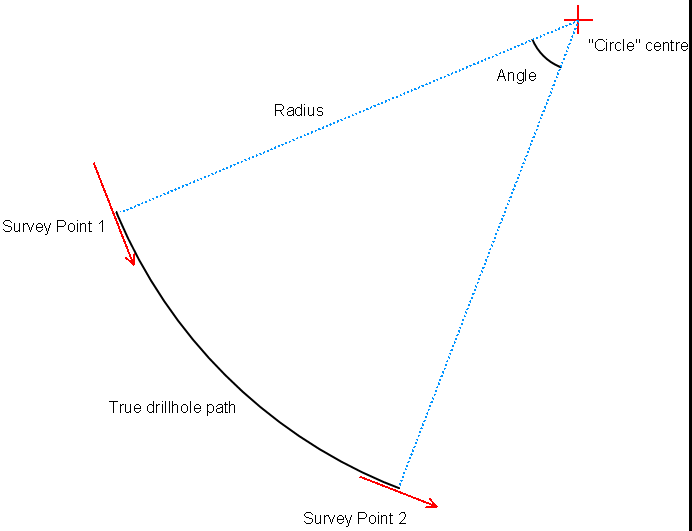
The Spherical Arc desurvey method uses two consecutive survey points, with the position of the first point known (either it is the collar position, or the previous segment's calculated end point) and constructs two unit vectors from the azimuth and dip. These vectors represent the direction at each survey point and the angle between the two directions is calculated. The assumption in calculating the angle is that any curve in the trace will continue smoothly along the sphere surface without any irregularities.
This is an especially accurate method of calculating the trace, in particular for holes that are curved significantly.
Balanced Tangent
The Balanced Tangent desurvey method uses a calculation method which treats half of a measured distance as tangent to the first survey point Inclination and Azimuth and the remainder of a second measured distance as being tangent to the next survey point Inclination and Azimuth.
A basic tangent algorithm holds the direction of a hole based on the last known measurement from the survey. When a new measurement is encountered, the direction will change or stay the same, accordingly.
With a balanced tangent method, equal weight is assigned to start and end survey measurements for straight lines. This method assumes that the direction between two survey points is straight and that any curve in the trace happens gradually across the whole interval. A balanced tangent algorithm improves accuracy over a basic tangent.